




Smart chatbots
Personalize your customer service with chatbots
Combine rule-based and AI chatbots in a single platform. Serve customers 24/7, qualify leads and resolve questions without losing the human touch.
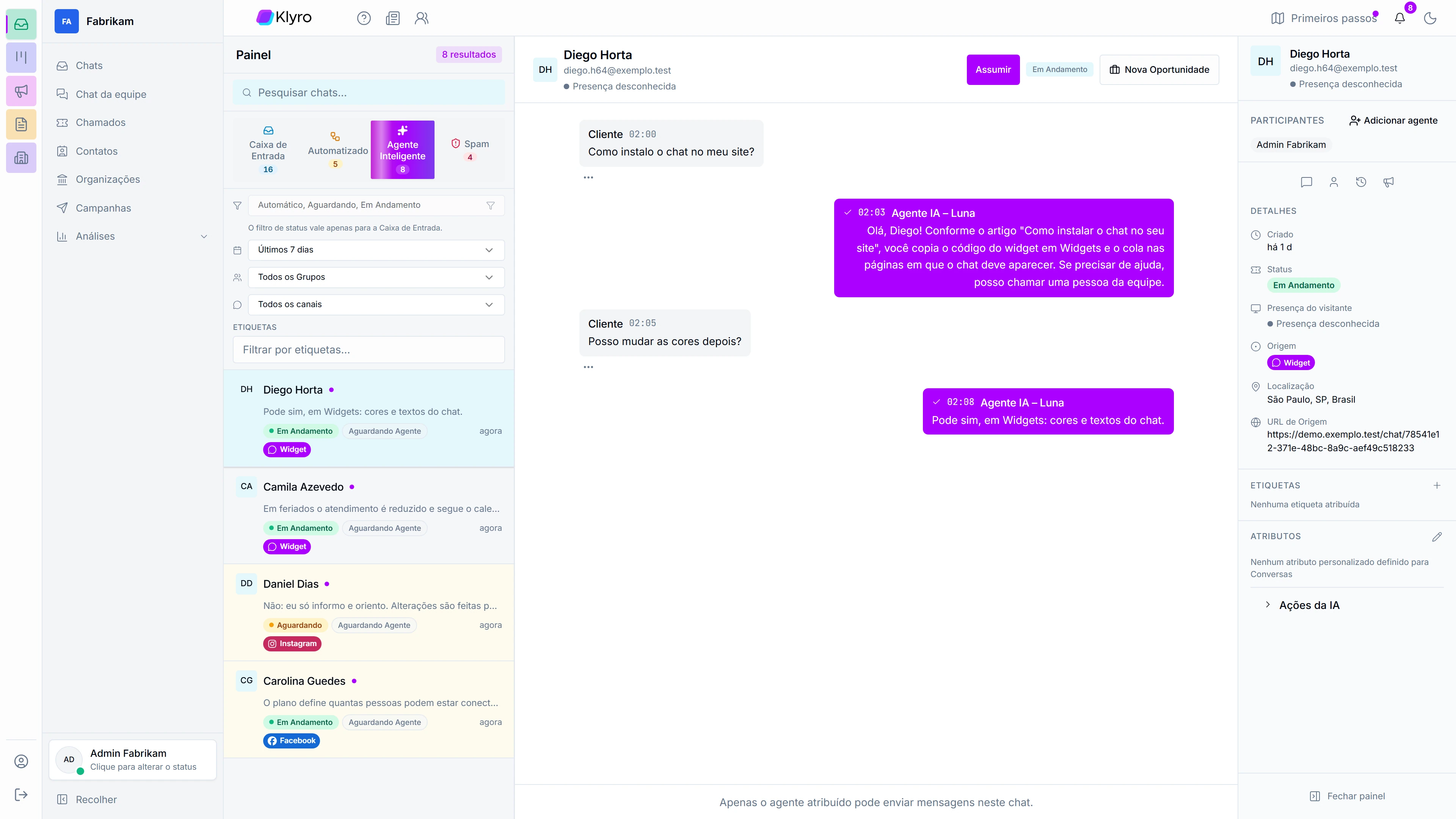
Illustrative example — demo data
Personalize your customer service
Every customer is unique. Build tailored experiences with bots that know the history, channel and moment of each conversation — and know exactly when to hand off to a human agent.
Brand identity & voice
Set name, avatar, language and tone so the bot feels like part of the team.
Rules + AI in one flow
Use decision trees for the predictable and generative AI for the open-ended.
Frictionless human handoff
Pass the conversation to a human with full context whenever needed.
Available on every channel
WhatsApp, Instagram, Messenger, Telegram, email and website — the same bot, everywhere.
Product screens
AI agent knowledge (company knowledge)
AI agent knowledge (agent knowledge)
AI agent: persona, instructions and hand-over to a person
The problem: An AI agent needs to know who it is, how to speak and how far it can go. And, when needed, hand the conversation over to a person.
You set the name, the role, the tone of voice and whether the agent uses emoji.
- Name: Bia
- Role: virtual assistant
- Tone: friendly
- Emoji: yes
Illustrative example
The agent introduces itself and speaks the way the company chose.
Step 1 of 5
Text description of this diagram
An AI agent needs to know who it is, how to speak and how far it can go. And, when needed, hand the conversation over to a person.
The steps, in order:
- Give it a persona. You set the name, the role, the tone of voice and whether the agent uses emoji. The agent introduces itself and speaks the way the company chose. (Name: Bia; Role: virtual assistant; Tone: friendly; Emoji: yes). Illustrative example.
- Write instructions. You write the agent's instructions and choose the channels, the departments and the quality tier. The agent knows what to do and where to work. (Site chat; Official WhatsApp; Instagram; Facebook; Telegram).
- Release sources. The agent only reads the knowledge sources you release to it. Nothing is read without your authorisation.
- Answer. The agent handles the conversation with the persona and the instructions you set. The customer is served on the channel they wrote on. “Hello, I need help with my purchase.” “Hi! I am Bia, a virtual assistant. Tell me what happened?” Illustrative example.
- Hand over to a person. When it decides to escalate, the agent hands the conversation to a person on the team, with the history. The person can also take over the conversation. The customer does not have to repeat the story. “Conversation handed over to a person, with the history.” “Hi! I am on the team and I have read what you told us.” Illustrative example.
Rule-based chatbot vs AI chatbot
It's not one or the other. Use each model where it shines — or combine both for the best of both worlds.
Rule-based chatbot
Predictable, auditable flows for well-defined processes.
- Built with decision trees and buttons
- Controlled answers, no surprises
- Great for FAQs, scheduling and lead qualification
- Easy to audit and keep compliant
- Solves repetitive scenarios at scale
AI chatbot
Natural conversations that understand intent, context and open language.
- Understands natural-language questions
- Answers grounded in your knowledge base
- Generates personalized replies in real time
- Learns from every conversation to keep improving
- Great for open support, recommendations and consultative sales
Where chatbots make a difference
24/7 customer service
Solve 70% of common questions without a queue or agent, any time of day.
Lead qualification
Filter interest, budget and segment before involving the sales team.
Automated post-sale
Track orders, schedule services and send satisfaction surveys.
Results that matter
Conversations solved by the bot
First response time
True availability
What it solves
Real situations Klyro chatbots solve
Rule-based bots and artificial intelligence bots, with the option to hand over to a person when needed.
The situation
The team answers the same question about hours, lead times or prices dozens of times a day.
How Klyro solves it
An AI bot trained with the company's documentation, website and knowledge base answers those questions, and a rule-based bot handles the predictable flows.
What changes
The team stops repeating answers and gives attention to cases that need a person.
The path to the solution
- 1A customer asks a common question
- 2The bot checks the knowledge base
- 3Replies naturally
- 4If solved, it closes
Frequently asked questions
What is the difference between a rule-based and an AI chatbot?
A rule-based bot follows decision trees and buttons, with controlled answers. An AI bot understands natural language and answers from the knowledge base. You can combine both.
Which channels do chatbots work on?
WhatsApp, Instagram, Messenger, Telegram and website chat. The AI agent does not answer e-mails.
How does the AI learn about my company?
It can be trained with your documentation, your website and your knowledge base.
Can the customer talk to a person?
Yes. The bot hands off to a human agent with the conversation context, and the AI can be turned off on every plan.
AI Agents
AI Agents that answer with your company’s knowledge
Train them on docs, your website and knowledge base. Included in every plan, with a clean human handoff when needed.
Train on your knowledge
Documents, website and knowledge base become real context in answers — not generic LLM guesses.
Quality per agent
Each agent has an AI quality tier. Use Economy for high-volume FAQ and higher tiers for hard reasoning.
Human handoff with context
When a person is needed, the agent takes over with the full history — the AI does not vanish mid-conversation.
Included in every plan
AI credits ship with the plan. No second subscription, no API keys, one invoice.
Ready to automate with intelligence?
Build a rule bot, an AI bot — or both — in minutes. No code, no headaches.